The Brotherhood of Sleeping Car Porters
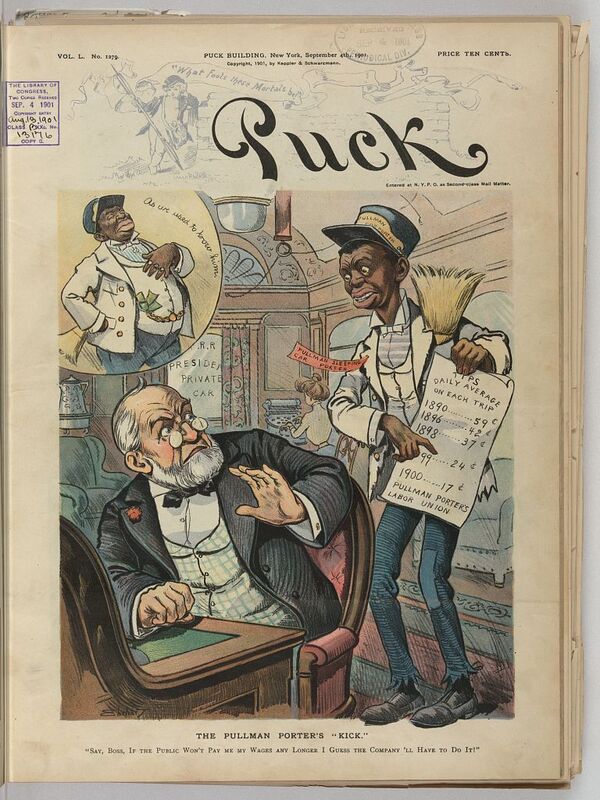
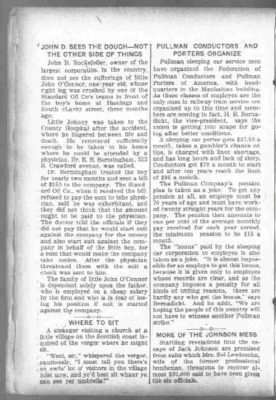
Despite the relative positive impact on the economics of the African American community, the porters were the lowest paid and most poorly treated of the railway workers. Tips was the only way the porter could earn a reasonable living. Tips were beneficial to the porter and the Pullman Company who relied on the passernters to pay the balance of the porters salary in tips. In 1914 a sleeping car porter received $27.50 a month while conductors got $70 and in ten years reached a maximum of $95/month . To receive a pension the porter had to be 70 years old and have worked a straight 28 years or the company. They then received a pension of 1cent per month for each year served. The Pullman Porter pension could be as low as $15.
In 1926, other railroad workers worked on a standard of 240 hours a month. Pullman porters could, under special circumstance be expected to work as many as 540 hours a month for a monthly wage. Under normal conditions, they were expected to do a 11,000-mile run for the basic monthly salary that amounted to 366-400 hours of work per month. Pullman Porters were also paid less for overtime, 18c/hour, while other railway workers were paid time and a half. To make a little more money most porters accumulated overtime for doubling and late arrivals but this came with added risk. Some Porters reported earning very little extra money doubling (leaving a point without any rest, to take another run). In fact very often, this practice caused the Porter lose money because they then had to opt out of their scheduled run. Once they missed their schedule run, the Porters were then forced to wait to get back on their scheduled. They were not paid for that layover . These wait times could stretch over one or two day
In 1927 their maximum salary after 15years of service was $83 with an addition of $13, (total of $96 per month), only if the porter also did conductor work or ‘runs in charge”. At this time minimum wage was $72/month. Porters had on vacation, they were required to report to duty regularly or they were put off the list. But if there was not a line for them to work they still had to report to work with no pay. A major part of the Porter’s job was to shine shoes, they were required to buy their own shoe polish, if they refused they could be given 15-30 days with no work. They were also penalized if they asked customers to pay for the service and didn’t receive any of the service charges recouped by the company. They were not paid for any time spent preparing the car for departure and their work hours began and ended when the train left and returned to the station.
In 1918, the War Labor Board mandate gave porters the right to begin collective bargaining and with the end of this Federal control of the railroad ended the porters began to organize. Naturally the compane became nervouse, and realized that this uniziation could be costly for the company and and they promptly introduced a company union in an attempt to block the porters from unionizing. The company controlled the union and it worked like an extension of the personnel department, obviously there to protect the company and not the workers. In 1925 Three porters, Ashely L. Totten, W.H. Des Verney and Roy Lancaster saw the need for an independent union and approached A Phillip Randolph to help establish and lead this new Union. Randolph although not a porter was known to be a vocal support of labor unionization, and was also the editor of a paper that could be used to publilze the cause. He had also previously been fired by the railroad for talking about unionization in 1917. He promptly accepted.
At this time, the big four railway unions- The Railway Men’s International Benevolent Industrial Association, the. National Order of Locomotive Firemen, and the Dining Care Cooks and Waiters Union. barred blacks from membership and other black unions were gaining strength. Finally the Brotherhood of Sleeping Car Porters union was launched in Harlem on August 25th, 1925 and the first branches were established in Washington, Boston, Chicago, St Louis, Kansas City, and Omaha, Nebraska. The Brotherhood of Sleeping Porters became the largest single trade union of Negro workers. Their main demands were
1. Minimum wages of $150/month instead of the average $72/month
2.A months service of 240hrs instead of the 400hrs often worked. Pullman Conductors was 400hrs/month.
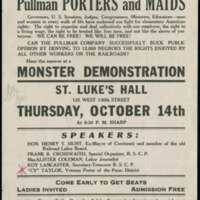
The Brotherhood continued to fight for full recognition from the Pullman Company and advocate for membership into the American Federation of Labor (AFL) . They put all their energies into recruiting and garnering support from the porters and held regular demonstration meetings at St Luke’s Hall in Harlem. By the end of 1926, half of the porters joined the Brotherhood and they had the support of the Chicago Federation of Labor, the National Association of for the Advancement of Colored People (NAACP) and the Urban League, and the union was granted financial aid and federal status by the AFL.
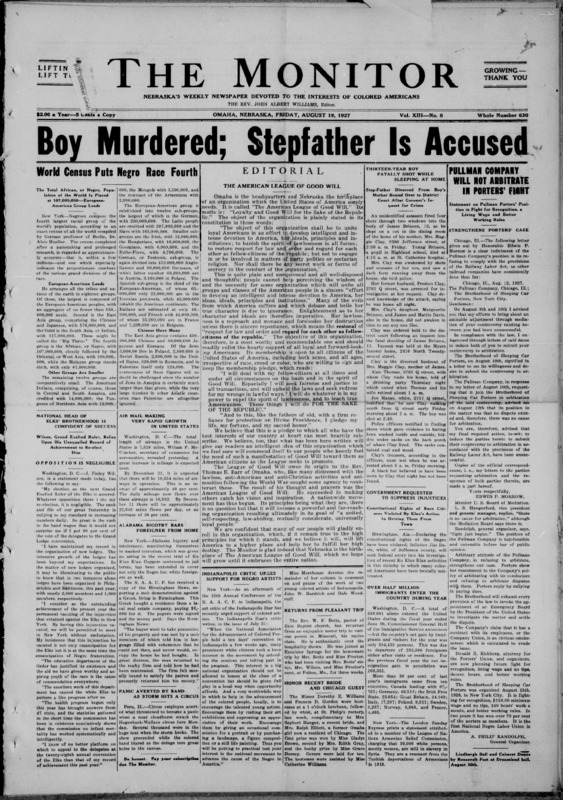
In 1927, a letter from Edwin P. Morrow in the Omaha Monitor, exposes the Pullman Company’s bias attitude towards the Brotherhood when after participating in arbitration with the conductors, the Company agreed to arbitration with the porters and then rescinded. This blatant noncompliance with the Railway Labor act angered the Brotherhood and Randolph saw this as a ‘call to arms. The Pullman company continued to resist the requests of the porters and then further aggravated the situation by introducing Chinese Americans as Club Car porters and Filipino porters as Buffet Porters on the Northwestern-Union Pacific lines (“Is This Another Threatening Gesture” ).
This resistance continued to energize the BSCP and they continued to fight for equal pay and shorter work weeks. On September 7th, they filed a petition to the Interstate Commerce commission requesting an investigation into low pay rates paid by the company and the distribution of the ‘service’ charge that passengers paid to the company for the porter’s service.
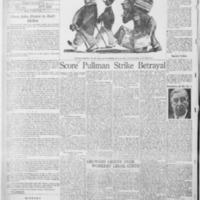
A 1928 Statement of the Central Executive of the Workers (Communist) Party in the Chicago Daily Worker reveals how the Workers Communist Party attempted to undermine the Brotherhood and for a while the Randolph-Webster leadership began to lose the support of their member when they called off their organized strike in support of a living wage and a reduced workday from 13hours to 8hrs. The editorial accuses the BSCP for minimizing issues of race discrimination and focusing solely on the work conditions of the porter. They called out the Union for becoming a ‘craft’ organization and not a union concerned with ‘race segregation’ .
They accused the Union of bluffing, suggesting that the BSCP had no intention of striking because of the Watson-Parker law that required arbitration and made all strikes illegal. He alleges that Randolph of arranged with Mr. Green, (the Company chairman) to send the wire to call off the strike and accuses the Randolph-Webster leadership of being as bad as the white labor union leaderships in not truly working to change the craft isolation, race segregation and no-strike policy of the A.F. of L.
The Communist party seized this opportunity to make public their support of the Negro trade unions, vowing to fight for one trade union for each industry addressing the race issues and positioning themselves as the defender of all Pullman Porters regardless of color. They set out a proposition to establish inter-racial committees to work on the unification of Negro and white workers. “Equal pay for equal work for Negro and White workers” . The party espoused its support for the Negro race- particularly the negro worker, declares itself as the ‘champion of the Negro as an oppressed race, outlines the fight of the communist party against capitalism and sets itself up as having the only political convention in which Negros participated equally with other delegates. The Workers Company then calls for the porters to strike and defy their leaders in the Brotherhood. This claim did not divide the Union, and porters continued to join and recruit other workers.
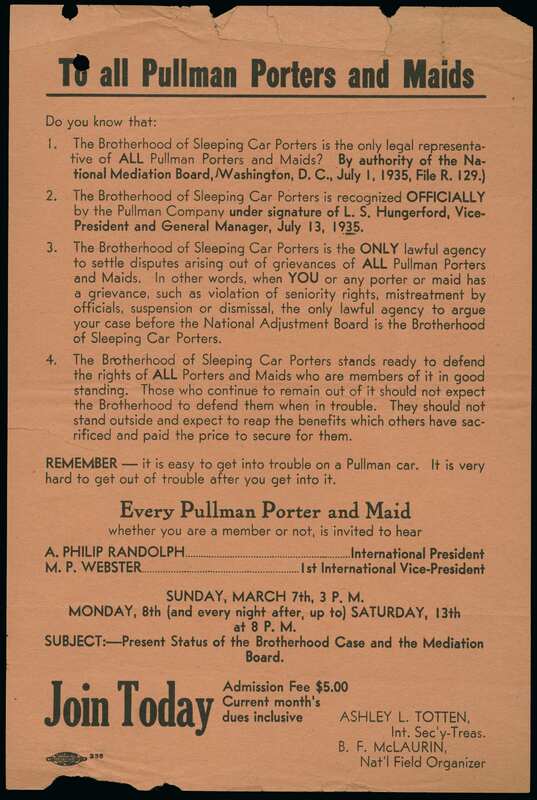
It was not until October 1935 that the BSCP was granted membership into the American Federation of Labor and two years later, in April 1937, after twelve years of resistance, the Pullman company made a contract to increase porter wages with a cap of 250 hrs./month. They made the formal announcement on August 25th, 1937. This was the first agreement ever signed between African Americans and a corporation.
Sources
- “Chinese Porters Replace Negro on Crack Trains” The monitor. [microfilm reel](Omaha, Neb.), 30 Dec. 1927. Chronicling America: Historic American Newspapers. Lib. of Congress. <https://chroniclingamerica.loc.gov/lccn/sn94055234/1927-12-30/ed-1/seq-1/>
- “Is This Another Threatening Gesture” The monitor. [microfilm reel] (Omaha, Neb.), 30 Dec. 1927. Chronicling America: Historic American Newspapers. Lib. of Congress. <https://chroniclingamerica.loc.gov/lccn/sn94055234/1927-12-30/ed-1/seq-1/>
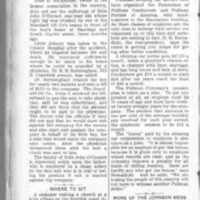
- “Pullman Conductors and Porters Organize”. The Day Book (Chicago, Ill.), 19 Jan. 1914. Chronicling America: Historic American Newspapers. Lib. of Congress. <https://chroniclingamerica.loc.gov/lccn/sn83045487/1914-01-19/ed-1/seq-8/>
- “Pullman Conductors and Porters Organize”. 1914. The Day Book (Chicago, Ill.), 19 Jan. 1914. Chronicling America: Historic American Newspapers. Lib. of Congress. <https://chroniclingamerica.loc.gov/lccn/sn83045487/1914-01-19/ed-1/seq-8/>
- Bates, Beth Tompkins. Pullman porters and the rise of protest politics in Black America, 1925-1945. Chapel Hill, N.C. : University of North Carolina Press
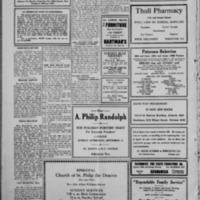
- Brotherhood of Sleeping Car Porters. (1927). The Pullman porter. New York: Brotherhood of Sleeping Car Porters. HaithiTrust. https://hdl.handle.net/2027/uc1.b4274673
- THE BROTHERHOOD OF SLEEPING CAR PORTERS AND OTHER BLACK UNIONS IN THE TRAIN SERVICE. (1981). In Foner P. & Lewis R. (Eds.), The Black Worker, Volume 6: He Era of Post-War Prosperity and the Great Depression, 1920-1936 (pp. 189-310). Philadelphia, Pennsylvania: Temple University Press. doi:10.2307/j.ctvn5tvxv.7. https://www.jstor.org/stable/j.ctvn5tvxv.7
- Brotherhood’s Attorney Discusses I.C.C. Case at Porter’s Mass meeting
The monitor. [microfilm reel](Omaha, Neb.), 25 Nov. 1927. Chronicling America: Historic American Newspapers. Lib. of Congress. <https://chroniclingamerica.loc.gov/lccn/sn94055234/1927-11-25/ed-1/seq-4/> - Illinois Railway Museum Libraries: Pullman Library https://www.irm.org/pullmanlibrary/
- Myers, Roy J. and Stephanie E. Myers. 2014.Remembering the Path to T-Town: Migration of an African American Family through Seven States to Lincoln, Nebraska 1720-1940. J. Myers Publishing Company
- Perata, David D. Those Pullman Blues : an Oral History of the African American Railroad Attendant . New York: Twayne Publishers, 1996. Print. HaithiTrust (35)
- Pullman Company Will Not Arbitrate in Porters Fight. The monitor.(Omaha, Neb.), 19 Aug. 1927. Chronicling America: Historic American Newspapers. Lib. of Congress. <https://chroniclingamerica.loc.gov/lccn/00225879/1927-08-19/ed-1/seq-1/>
- Pullman Porters File Petition with Commerce Commission. The monitor.(Omaha, Neb.), 16 Sept. 1927. Chronicling America: Historic American Newspapers. Lib. of Congress. <https://chroniclingamerica.loc.gov/lccn/00225879/1927-09-16/ed-1/seq-2/
- Pullman Porters, Creating A Black Middle Class. Fresh Air. May 8, 2009.
- Pullman Porters: Topics in Chronicling America. Library of Congress LibGuide.
- Railroad Archives. The Newberry Library. https://www.newberry.org/railroad-archives
- Santino, Jack. Miles of Smiles, Years of Struggle : Stories of Black Pullman Porters . Illini books ed. Urbana: University of Illinois Press, 1991. Print. HaithiTrust https://hdl.handle.net/2027/mdp.39015013941193
- Score Pullman Strike Betrayal”. The daily worker. (Chicago, Ill.), 12 June 1928. Chronicling America: Historic American Newspapers. Lib. of Congress. <https://chroniclingamerica.loc.gov/lccn/sn84020097/1928-06-12/ed-1/seq-4/>
- The Historic Achievement of the Pullman Porters Union. JSTOR Daily, February 1, 2016.
- The Legacy of Pullman Porters, Museum of the American Railroad
- The National A. Philip Randolph Pullman Porter Museum
- This Day in History: The Pullman Porters. https://www.history.com/topics/black-history/pullman-porters
- Tramble, Thomas., and Wilma. Tramble. 2007. The Pullman Porters and West Oakland. Charleston, SC: Arcadia Pub.
- Tye, Larry. 2004. Rising from the Rails : Pullman Porters and the Making of the Black Middle Class. New York: Henry Holt.
- Victory is Drawing Near For Pullman Porters Union|. The monitor. [microfilm reel](Omaha, Neb.), 24 Feb. 1928. Chronicling America: Historic American Newspapers. Lib. of Congress. <https://chroniclingamerica.loc.gov/lccn/sn94055234/1928-02-24/ed-1/seq-1/>